A lunar cycle runs about 29.5 days. Astrologers and almanacs divide it into eight phases of roughly 3.7 days each, defined by the angle between the sun and the moon as seen from Earth. The moon produces no light of its own — half of it is always lit, and the phases are simply how much of that lit half is turned toward us.
This page is the reference for all eight. Each one links out to the fuller guides where they exist.
The waxing half — light increasing
1 · New moon 0–45° · 0% lit
The moon sits between Earth and the sun, so the lit side faces entirely away from us. Invisible — it rises and sets with the sun. Traditionally the phase of beginning: the impulse before the plan, when nothing is visible yet.
Setting intentions at the new moon
2 · Waxing crescent 45–90° · up to ~25%
A thin curve appearing in the west just after sunset — the first sight of the new cycle. Traditionally the phase of first effort: pushing against the inertia that was not there when the idea was only an idea.
3 · First quarter 90–135° · 50% lit
Half the disc lit, dividing line straight down the middle, highest in the sky around sunset. Traditionally the crisis of action — the point where a decision has to be made and defended.
Half moon meaning and symbolism
4 · Waxing gibbous 135–180° · up to ~99%
More than half lit, visibly rounding out, up for most of the evening. Traditionally the phase of refinement — adjusting and correcting toward something that is nearly there.
Full moon
5 · Full moon 180–225° · 100% lit
Earth sits between sun and moon, so the whole lit face turns toward us. Rises at sunset, sets at sunrise, up all night. Traditionally the phase of culmination — seeing clearly what a cycle has produced, for better or worse.
Grounding practices for the full moon · Blue moon · Flower moon · Snow moon
The waning half — light decreasing
6 · Waning gibbous 225–270°
Past full and beginning to shrink, rising later each night. Traditionally the disseminating phase — sharing, teaching, passing on what the cycle produced rather than holding it.
7 · Last quarter 270–315° · 50% lit
Half lit again, mirror image of the first quarter, rising around midnight and highest at dawn. Traditionally the crisis of meaning — asking whether the belief that drove the cycle still holds.
Half moon meaning and symbolism
8 · Balsamic moon 315–360° · ~15% down to 0
A thinning crescent visible low in the east before dawn, then gone. Traditionally the phase of release and rest — the only part of the cycle every tradition agrees should be left empty.
Moonrise shifts about 50 minutes later each day. That single fact explains most of what confuses people about the moon: why a waxing moon is an evening sight and a waning one a morning sight, why the full moon is up all night, and why the balsamic moon is the one almost nobody has knowingly seen.
Working with the phases
Guides to using the lunar cycle as a reflection rhythm rather than a forecast.
- Syncing self-care with the moon phases
- Moon phases and habit building
- Lunar cycles as a productivity framework
- Moon phases and financial planning
- Virtual new moon circles
- The moon and agriculture
- Biodynamic farming and lunar cycles
A page for every phase
An eBook, audiobook and printable workbook that walks one complete lunar cycle, with a separate spread for each of the eight phases on this page.
Explore Lunar FlowCommon questions
How long is one full moon cycle?
About 29.53 days from one new moon to the next. This is called a synodic month. It differs from the 27.3-day sidereal month, which is the time the moon takes to return to the same position against the stars — the extra two days exist because Earth has also moved along its orbit.
What are the eight moon phases in order?
New moon, waxing crescent, first quarter, waxing gibbous, full moon, waning gibbous, last quarter, and balsamic or waning crescent. Waxing means the lit portion is growing; waning means it is shrinking.
What is the difference between a quarter moon and a half moon?
They are the same phase under two names. Half moon describes what you see — half the disc lit. Quarter moon describes where the moon is in its cycle — one quarter or three quarters of the way through the lunar month.
Why can I sometimes see the moon during the day?
Because the moon's rise and set times shift by roughly 50 minutes each day, it is above the horizon during daylight for much of the month. A waxing moon is often visible in the afternoon and a waning moon in the morning. Only the full moon is reliably a night-only sight.
Does everyone on Earth see the same moon phase?
Yes. The phase is determined by the angle between the sun, Earth and moon, so it is the same everywhere at any given moment. What changes with location is orientation — in the southern hemisphere the lit side appears on the opposite side to the northern hemisphere view.
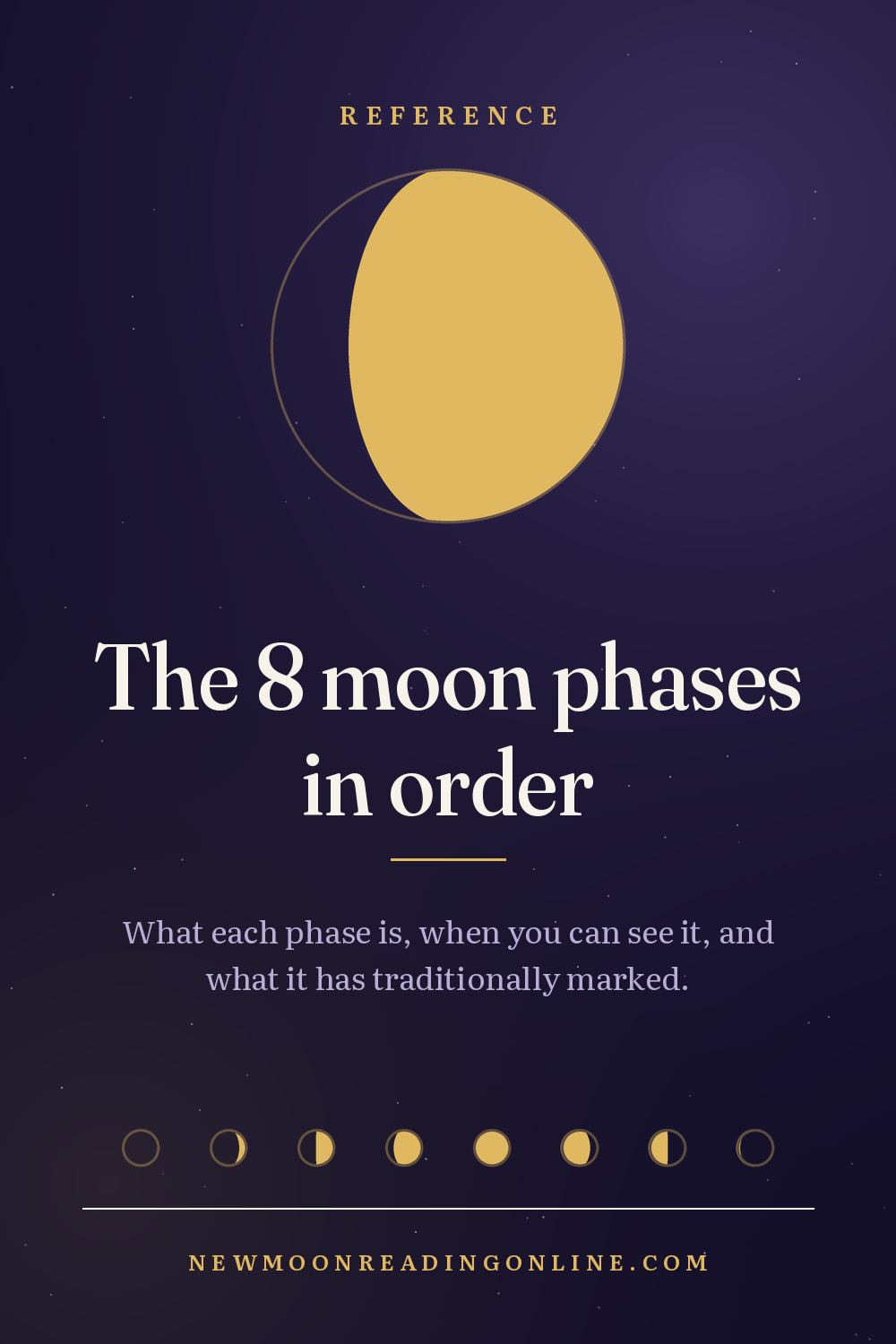
Pin it for later
Keep this one to hand — save it to a board and come back when you need it.
Save to Pinterest