The balsamic moon is the last phase of the lunar cycle — roughly the final three and a half days before the new moon, when the crescent has thinned to a sliver and then vanished altogether. In astrology it is the phase of completion: the part of the cycle for ending, releasing and resting rather than beginning anything.
It is also the phase most people never see. A balsamic moon rises somewhere between two and five in the morning and sits low in the east just ahead of the sunrise that washes it out. If you have never knowingly looked at one, that is not carelessness. You have to be up early and looking in the right direction.
What a balsamic moon actually is
The lunar cycle takes about 29.5 days. Astrologers divide it into eight phases of roughly 3.7 days each, measured by the angle between the sun and the moon as seen from Earth. The balsamic moon is the eighth and last of these, covering the final 45 degrees before the two line up again at the new moon.
Across the balsamic phase the moon's illuminated fraction falls from roughly 15% to zero. The lit edge is a thin curve on the left side as seen from the northern hemisphere, and on the right from the southern. Moonrise falls in the small hours and moonset in the early afternoon, which is why the phase is visible only in the pre-dawn eastern sky.
Two things about that geometry matter for the symbolism, and both are literally true rather than metaphorical. First, the balsamic moon is closing the distance to the sun — it is not moving away from anything, it is arriving. Second, the light is not going out. It is on the far side of the moon, facing away from us. Nothing is being lost; the visible portion is simply turning away.
Where the name comes from
The eight-phase names most astrologers use today — new, crescent, first quarter, gibbous, full, disseminating, last quarter, balsamic — were popularized in the twentieth century by the astrologer Dane Rudhyar, building on earlier work by Marc Edmund Jones.
Balsam is the aromatic resin that certain trees produce when their bark is wounded. Historically it was collected for healing salves, incense and preserving. To make it usable you reduce it: boil off everything volatile until what is left is concentrated and stable.
That reduction is the whole idea of the phase. Not an ending as loss, but a cycle boiled down to the small amount of it that was actually worth keeping.
Where it sits in the eight-phase cycle
The balsamic moon only makes sense in relation to what came before it. Here is the full sequence, with the angular separation between sun and moon that defines each one.
| Phase | Separation | Traditionally marks |
|---|---|---|
| New | 0–45° | Beginning; the impulse before the plan |
| Crescent | 45–90° | First effort; pushing against inertia |
| First quarter | 90–135° | Crisis of action; the decision point |
| Gibbous | 135–180° | Refining; adjusting toward the goal |
| Full | 180–225° | Culmination; seeing the thing clearly |
| Disseminating | 225–270° | Sharing; teaching what was learned |
| Last quarter | 270–315° | Crisis of consciousness; letting the form go |
| Balsamic | 315–360° | Release, rest, distillation, seeding the next cycle |
Read down that column and the shape is clear. The cycle does not run beginning-to-end. It runs beginning-to-culmination-to-distribution-to-release, and the release is what makes the next beginning possible. If you want the middle of the sequence in more depth, our guide to the half moon covers both quarter phases.
What the balsamic moon has traditionally marked
Across almanac, gardening and astrological traditions, the balsamic phase gets remarkably consistent treatment: it is the one part of the cycle everyone agrees you should leave empty.
- Completion over initiation. Finish what is open. Do not start what is new.
- Release. Clear out, give away, delete, forgive, close accounts — whatever version applies.
- Rest. Lower energy is treated as appropriate here rather than as a problem to fix.
- Review. Look back over the cycle that is ending and name what actually happened in it.
- Seeding. Whatever survives the review becomes the seed for the next new moon.
Gardening tradition follows the same logic literally: the balsamic quarter is for weeding, pruning, composting and soil work, not sowing. We look at how much of that has agronomic support in the moon and agriculture.
Born under a balsamic moon
Your natal moon phase is fixed by the angle between the sun and moon at the moment you were born. If that separation was between 315 and 360 degrees, you were born under a balsamic moon. It is one of the more distinctive placements in the eight-phase system, and it is the reason most people arrive at this page.
The traditional reading runs like this:
The sense of arriving at the end of something
Balsamic moon people are described as carrying a feeling of completion rather than beginning — as though they arrived to finish a story that started before them. Rudhyar's framing was explicitly about being a bridge between cycles: the person who closes one thing so the next can open.
Being slightly out of step
The most consistently reported experience is a mild, lifelong offset from peers. Interested in different things at different times, ready to leave when others are settling in, settling when others are leaving. Not alienation exactly — more a persistent quarter-turn out of phase.
Comfort with solitude
The balsamic phase is the private end of the cycle, and the placement is read as needing genuine alone time to process rather than as preferring it socially. The distinction matters: this is described as a processing requirement, not a personality preference.
An instinct for endings
Balsamic moon people are said to be unusually good at knowing when something is finished — a job, a relationship, a project, a version of themselves — and often know it well before anyone around them agrees.
None of the above is a measurable psychological trait. Natal moon phase has not been shown to predict personality under controlled conditions, and descriptions like these are broad enough that most people find something recognisable in them. They are useful as a reflective frame, not as a diagnosis — and they are more interesting when you hold them that way.
If you want to know which sign your moon was in as well as which phase, that is a separate question, covered in the moon sign today.
Balsamic moon, dark moon, waning crescent
Three terms, heavily overlapping, used inconsistently. Here is the cleanest way to hold them apart.
| Term | What it usually means | Which tradition |
|---|---|---|
| Waning crescent | The visual description — a thinning crescent, any time between last quarter and new moon | Astronomy |
| Balsamic moon | The final 45° of the cycle, about the last 3.5 days | Astrology (eight-phase system) |
| Dark moon | Most often the last 2–3 days when the moon is effectively invisible; sometimes used for the new moon itself | Folk and contemporary practice |
In practice, balsamic and dark moon point at nearly the same stretch of days and are frequently used interchangeably. Waning crescent is the wider category that contains both. The one genuine ambiguity to watch for is writers who use dark moon to mean the new moon — if a source says to set intentions at the dark moon, that is the sense they mean.
What to do during a balsamic moon
The phase lasts about three and a half days and comes round every month, so this does not need to be elaborate.
- Do not start. If something new can wait a few days for the new moon, let it. This is the single instruction every tradition agrees on.
- Close open loops. Send the reply you have been putting off. Finish the almost-done thing. Cancel what you know you are not going to do.
- Clear one physical space. A drawer, a folder, an inbox. Small and finite works better here than ambitious.
- Write the review before the intentions. Ask what actually happened this cycle, what worked, and what you are carrying forward. Save the goal-setting for the new moon three days later — the review is what makes it worth anything.
- Let the energy be low. If you are tired at the end of the month, treat that as the phase doing its job rather than as falling behind.
The balsamic moon is the only phase whose instruction is to do less. That is unusual enough in any practice system that it is worth taking seriously, whatever you think of the astrology.
A page for every phase, including this one
The Lunar Flow kit is an eBook, audiobook and printable workbook that walks one full lunar cycle — with a balsamic-phase review spread designed for exactly the kind of stock-taking described above.
Explore Lunar FlowCommon questions
What is a balsamic moon?
The balsamic moon is the eighth and final phase of the lunar cycle, running roughly the last three and a half days before the new moon. The moon appears as a thin waning crescent, lit from below about 15% down to nothing, and rises in the small hours so it is only visible low in the eastern sky shortly before sunrise.
What does a balsamic moon mean spiritually?
In lunar tradition the balsamic moon marks completion rather than beginning. It is associated with release, rest, review and the distilling of a cycle down to what is worth carrying forward. Almost every planting and practice tradition treats it as a phase for clearing rather than starting.
What does it mean to be born under a balsamic moon?
Astrologers describe a natal balsamic moon as the placement of someone finishing something rather than starting it. The common reading includes a sense of being slightly out of step with peers, a comfort with solitude, an instinct for endings, and a pull toward work that closes loops. This is a symbolic interpretation, not a measurable trait.
Is the balsamic moon the same as the dark moon?
Usually, though the terms are used loosely. Dark moon most often refers to the last two or three days of the cycle when the moon is effectively invisible, which sits inside the balsamic phase. Some writers use dark moon to mean the new moon itself, which is why the terms get tangled.
Why is it called balsamic?
The name comes from balsam, the aromatic resin used historically for healing and preserving. It carries the idea of a substance reduced to its essence — which is the symbolic role the phase plays in the eight-phase lunation cycle.
What should you do during a balsamic moon?
Traditionally: finish, clear, rest and review. Close out tasks rather than opening new ones, tidy and declutter, and take stock of the cycle that is ending. Almanac gardening traditions use it for weeding, pruning and soil work rather than sowing.
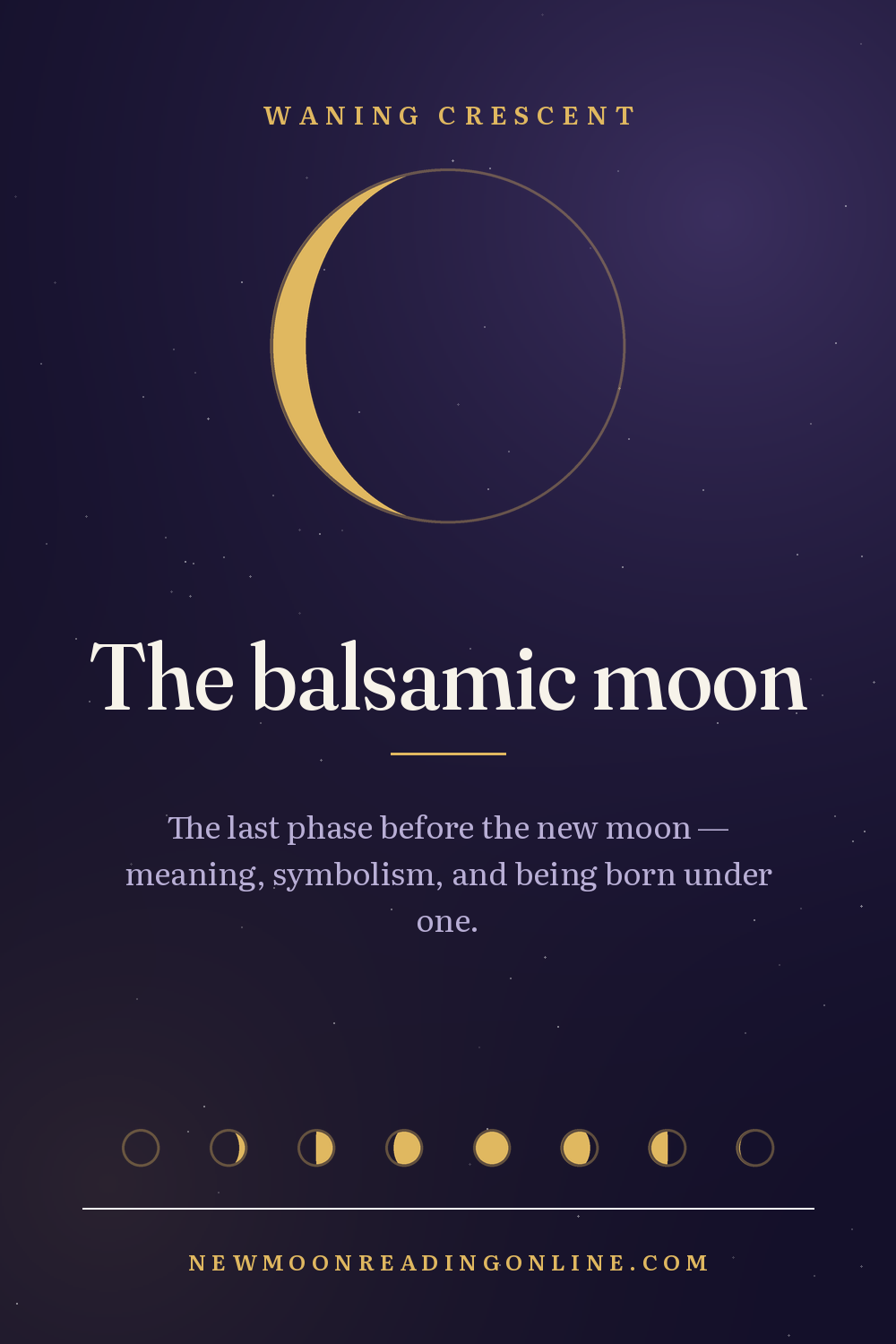
Pin it for later
Keep this one to hand — save it to a board and come back when you need it.
Save to Pinterest