
Ever felt your energy shift suddenly? Wondered if the universe was nudging you? Many of us feel these changes but often miss the cosmic dance above us.
What is this phenomenon? This transit explanation shows how the Moon moves between bodies and us. We see these cool moments when the Moon blocks our view, like the Sun.
Understanding this event meaning helps us grasp why some weeks feel lighter or tense. By exploring these movements, we learn how they impact our lives. For example, we might learn to better handle our emotions.
When the Moon seems to dance across the Sun, it changes our view. Scientists use the Solar Dynamics Observatory to watch these events. These moments show our world’s connection to solar rhythms.
Key Takeaways
- A passage happens when the Moon moves between observers and other celestial bodies.
- These cycles clarify why our mental state feels lighter or more tense during the week.
- Perspective shifts during these events make the Moon appear to pause or double back.
- Solar Dynamics Observatory data help scientists track these fascinating solar moments.
- Aligning with these rhythms supports emotional insight and personal growth.
Understanding the Basics of Lunar Transits
To grasp lunar transits, you need to know about the Moon’s orbit and how it interacts with other celestial bodies. These transits happen when the Moon blocks our view of planets or stars from Earth. This lunar movement phenomenon is key in astronomy and astrology.
The Moon’s orbit is not a perfect circle and is tilted compared to Earth’s orbit. This tilt and the Moon’s shape make its movement complex. For more on the Moon’s transit and its astrological meaning, check out Cafe Astrology.
Definition of a Lunar Transit
A lunar transit is when the Moon blocks our view of a celestial body. It’s a chance for astronomers to study the occulted body and the Moon’s path. The celestial bodies alignment during a lunar transit is rare and captivating.
“The Moon’s passage in front of a planet or star can reveal details about the Moon’s orbital path and the characteristics of the occulted celestial body.”
How It Differs from Solar Transits
Solar transits involve a planet passing in front of the Sun. They are less common than lunar transits and need specific conditions. For insights into how lunar transits affect personal astrology, New Moon Reading Online is a good resource.
| Transit Type | Celestial Bodies Involved | Frequency |
|---|---|---|
| Lunar Transit | Moon and other celestial bodies (stars, planets) | Relatively frequent |
| Solar Transit | Planets (Mercury, Venus) and the Sun | Less frequent |
The Science Behind Lunar Transits
Exploring the science of lunar transits reveals the Moon’s path through the sky. This knowledge is key to understanding their importance in astronomy and astrology.
The Moon’s Orbit Explained
The Moon’s orbit is not a perfect circle. It’s an ellipse that changes the Moon’s size in the sky. Lunar orbit crossing is significant during a transit. It affects both astronomy and astrology.
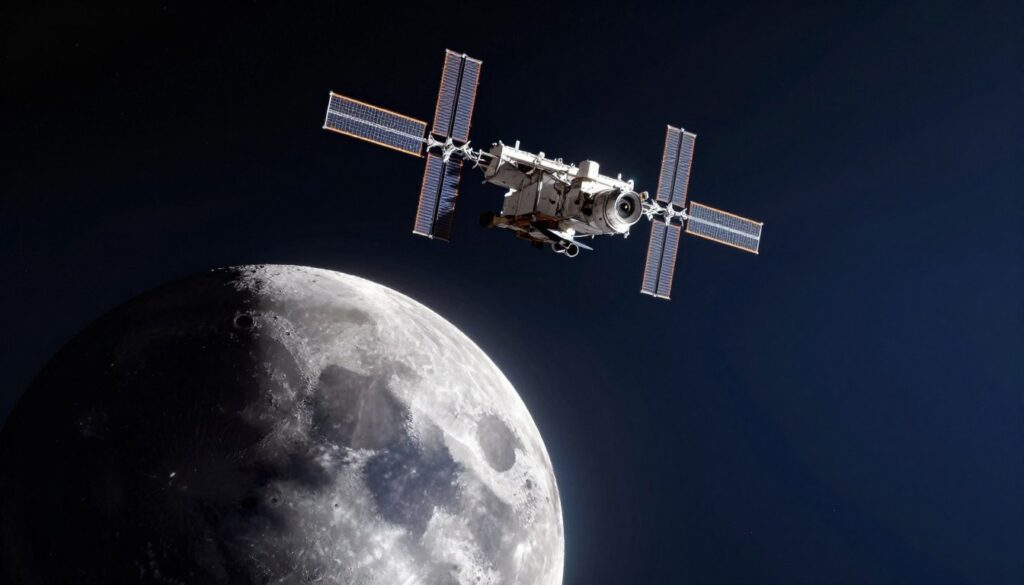
The Moon orbits Earth in about 27.3 days, called the sidereal month. But it takes 29.5 days to return to the same phase, known as the synodic month. This difference comes from Earth’s orbit around the Sun.
Phases of the Moon and Their Relation
The Moon’s phases change as it moves around Earth. Different amounts of its light are seen, creating the phases we see. Knowing these phases helps us understand lunar transits better.
A lunar transit during a full moon is different from one during a new moon. The astronomical event definition includes the Moon’s phase. This context is important.
Studying the Moon’s orbit and phases helps us understand lunar transits. They play a big role in both astronomy and astrology.
Historical Significance of Lunar Transits
Lunar transits have been key in shaping our cultural and astronomical views. These events, though less common than solar eclipses, were very important in history. They were seen as significant across many cultures and times.
Looking into how ancient societies saw lunar events helps us understand their lunar passage significance. The Moon has always been a big part of human culture. It’s linked to myths, spirituality, and the natural world.
Ancient Civilizations and the Moon
Many old cultures worshipped the Moon, giving it myths and gods. For example, the Greeks had Selene, and the Romans had Luna. These groups watched the Moon’s phases and its rare sky passes. They saw these as signs or big celestial events.
To learn more about these ancient views, check out the Exploratorium’s talk on transits.
Cultural Beliefs Surrounding Lunar Events
Lunar transits and eclipses meant different things to different cultures. They showed each society’s unique knowledge and myths. In some places, a lunar transit was seen as a sign of big changes to come.
By looking at these beliefs and old observations, we see how special lunar transits are. They help us understand the Moon’s role in our history. They also make us appreciate the amazing sky events that catch our eye today.
Lunar Transits in Astrology
In astrology, a moon transit is key to understanding how the stars affect us. These transits help us see into life’s many facets and our own personalities.
Experts look at the Moon’s path through our birth chart’s houses and its connections to planets. This helps uncover emotional changes, how we relate to others, and chances for growth. For more on lunar transits, check out this detailed guide.
How Astrologers Interpret Lunar Transits
Astrologers use the Moon’s journey through our chart’s houses to grasp our emotional and mental states. For example, a Moon transit in the 4th house might focus on family and feelings. A transit in the 7th house could spotlight our relationships and partnerships.
Impact on Personal Horoscope
Lunar transits can deeply affect our personal horoscopes, touching on different life areas. A transit might make us more emotionally sensitive or call for self-reflection. To see how these transits might shape your horoscope, look into new moon readings for personal growth.
Grasping lunar transits and their meanings helps us tackle life’s ups and downs. It guides us in making choices based on the stars’ wisdom.
Observing a Lunar Transit
Watching a lunar transit is more than just a pretty sight. It’s a chance to learn about the lunar event meaning. As we watch, we discover the secrets of our universe’s workings.
To get the most out of this event, being ready is key. For more on transits and how they work, check out NASA’s Space Place. They have great explanations and resources.
Best Practices for Viewing
Timing and location are key when watching a lunar transit. Choose a spot with little light pollution for better viewing. Also, check the weather forecast to make sure it’s clear.
- Find a comfy spot with a clear view of the horizon.
- Wear the right clothes for the weather.
- Let your eyes get used to the dark to see better.
Tools You Might Need
While you can watch lunar transits with your eyes, the right tools can make it better. Binoculars or a telescope let you see the Moon up close.
If you want to take pictures, a camera with a good zoom is helpful. Use a tripod to keep the camera steady and avoid blurry photos.
The Role of Lunar Transits in Astronomy
Lunar transits give astronomers a special chance to see how celestial bodies align. This happens when the Moon moves in front of a planet or star. It’s a rare view into our solar system’s workings.
Looking into lunar transits, we see they’re key to understanding the universe. The Moon’s orbit isn’t perfect, and its distance from Earth changes. This affects how often and how lunar transits happen.
Impact on Telescopic Observations
Lunar transits can change what we see through telescopes. The Moon can block or highlight certain features, depending on the object and its position. Astronomers need to plan well to make the most of these moments.
For example, the Moon can act as a natural coronagraph during a transit. It blocks a bright star’s light, letting us see fainter objects. This is great for studying the surroundings of stars and planets.
Case Studies of Significant Lunar Transits
Many important lunar transits have been studied by astronomers. One example is when a planet moves across the Moon’s disk. It gave us insights into the planet’s atmosphere and the Moon’s orbit.
These studies show how vital lunar transits are for learning about our solar system. By studying these events, astronomers improve their models of the universe. They gain a deeper understanding of the complex interactions in our cosmic neighborhood.
Common Misconceptions about Lunar Transits
Lunar transits are truly amazing but often misunderstood. This leads to many myths. Learning the truth about these events can make us appreciate the universe more.
Many people mix up lunar transits with other sky events. This mix of myths and facts can be confusing. Let’s clear up some of these misconceptions and explain what lunar transits really are.
Debunking Popular Myths
One myth is that lunar transits are very rare and hard to see. While they do need a specific alignment, they’re not as rare as thought. Thanks to astronomy, we can now predict and watch these events more easily.
- Lunar transits are linked to big astrological events, but their real importance is about the alignment of stars and planets.
- Some think lunar transits affect Earth’s tides or weather, but there’s little science to back this up.
By learning the science behind lunar transits, we can clear up these myths. This way, we can enjoy these events without misunderstanding their importance.
Clarifying Terminology: Eclipses vs. Transits
Many get confused between lunar eclipses and lunar transits. A lunar eclipse happens when the Earth blocks the Sun’s light from reaching the Moon. On the other hand, a lunar transit is when the Moon passes in front of a planet or star, hiding its light from us.
To make things clear, let’s look at the main differences:
| Event | Description | Observation |
|---|---|---|
| Lunar Eclipse | Earth between Sun and Moon | Shadow on the Moon |
| Lunar Transit | Moon in front of a celestial body | Blocking the celestial body’s light |
Knowing these differences helps us better understand lunar transits. It shows their special role in astronomy.
As we learn more about lunar transits, we clear up myths and connect deeper with the universe. Watching these events helps us appreciate the beauty and complexity of the sky.
Current Research on Lunar Transits
The study of lunar transits is growing, with new findings changing how we see the universe. As we explore space, lunar transits are a key area of study in astronomy.
Lunar transits are a big astronomical event that scientists are really interested in. They help us understand the Moon’s path and how it moves with the Earth and Sun.
Recent Discoveries in Astronomy
Recent studies have focused on measuring lunar transits accurately. This gives us important data on the Moon’s orbit. It helps us understand the Earth-Moon-Sun system better.
For example, researchers have studied the Moon’s orbital shape and tilt. These studies have helped us learn about the Moon’s past and how it changed.
Future Predictions and Their Implications
As research goes on, predictions for lunar transits are getting better. These predictions are key for astronomers and for knowing how lunar transits might affect Earth’s tides and satellites.
By looking at past transits and using advanced models, scientists can predict future ones more accurately. This info is useful for many, from astronomers to policymakers.
| Year | Predicted Lunar Transit Events | Significance |
|---|---|---|
| 2025 | Total Lunar Transit | Rare alignment of Earth, Moon, and Sun |
| 2030 | Partial Lunar Transit | Visible from Eastern Hemisphere |
| 2035 | Penumbral Lunar Transit | Subtle effects on Earth’s tides |
If you’re planning trips, knowing about lunar transits can be helpful. You can learn more about planning your trips on auspicious dates, like during new moon readings, on our page: New Moon Readings for Travel.
Conclusion: The Importance of Lunar Transits
Exploring the cosmos makes understanding lunar transits more important. It’s not just about space events; it touches our emotions and spirits.
Understanding Lunar Transits for Personal Growth
Learning about lunar transits helps us understand our feelings better. The Moon’s journey through the zodiac signs and its meetings with planets like Saturn and Jupiter give us clues about ourselves. For example, a Moon transit can show how we feel, affecting our daily lives in big ways.
Observing and Appreciating Lunar Transits
We suggest watching these lunar events closely. This way, you’ll see changes in yourself and the world. It helps you understand the lunar cycle better and appreciate the beauty of the sky.
[…] journal can be incredibly helpful. Tracking energy levels throughout the different phases of the moon allows us to recognize…
[…] Reading is a new platform that offers personalized insights based on the lunar cycle1. It’s different from generic horoscopes,…
[…] As we set intentions aligned with the New Moon energy, we open ourselves to the power of manifestation. By…
[…] intentions during the new moon is a powerful practice that allows me to declare my goals and aspirations. It…
[…] These readings provide a convenient and accessible way to connect with the energies of the new moon and gain…