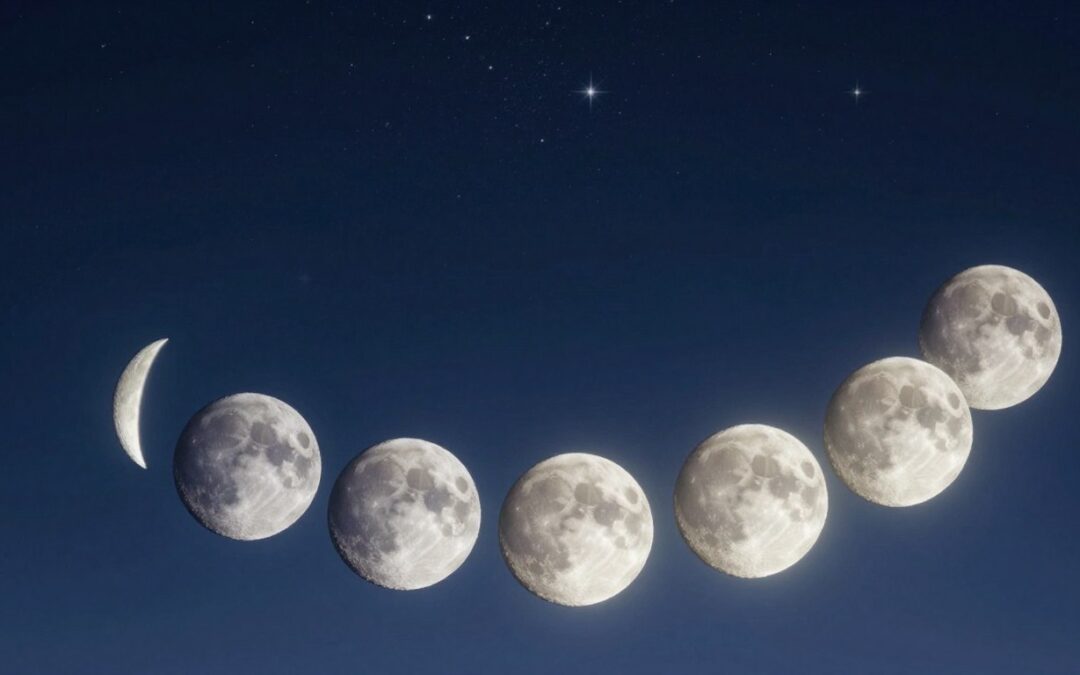
Have you ever looked up at the midnight sky and wondered about the moon’s shape? This dance in the sky has fascinated us for thousands of years. It helped guide ancient calendars, inspired myths, and kept our ancestors safe at sea.
This pattern is called one lunation. It’s the time between new moons or full moons. It’s amazing how the sky keeps this exact schedule every month.
The lunar cycle duration is about 29.5 days on average. In this time, the moon goes through different phases as it orbits Earth. This rhythm feels very personal to us, even though distant stars are cold.
Many people wonder, how long is a complete lunar cycle? Knowing this helps us understand our planet’s natural rhythms better.
Key Takeaways
- One lunation covers the time between two new moons.
- This orbital period averages 29.5 days in length.
- We observe eight distinct moon phases every month.
- Ancient cultures relied on these patterns for navigation.
- Understanding these shifts connects us to natural rhythms.
- Full moon occurrences repeat according to this exact schedule.
Understanding the Lunar Cycle
The Moon orbits the Earth, creating phases that change our view of the night sky. These phases also affect Earth’s natural rhythms. To fully understand the lunar cycle, we need to know its definition and the different phases it goes through.
Definition of the Lunar Cycle
The lunar cycle is the Moon’s phases as it orbits the Earth. It’s influenced by the Earth, Moon, and Sun’s positions. This cycle is also called a lunar month or lunation. The lunar cycle lasts about the same as the lunar month duration, which is the time for the Moon to go through one cycle of phases.
Phases of the Moon
The Moon goes through several phases, mainly based on its position relative to the Earth and Sun. These include the New Moon, First Quarter, Full Moon, and Last Quarter. For more on these phases and their importance, check out a beginner’s guide to lunar influence.
The lunar cycle’s phases come from the changing angles of the Sun’s light as the Moon orbits the Earth. This changes how much of the Moon’s illuminated surface we can see from our planet.
| Phase | Description | Characteristics |
|---|---|---|
| New Moon | The side of the Moon facing the Earth is not illuminated by the Sun. | Invisible from Earth, marks the beginning of a new cycle. |
| First Quarter | The Moon is half-illuminated, with the right half visible from Earth. | Represents a quarter of the lunar cycle’s completion. |
| Full Moon | The entire face of the Moon is illuminated by the Sun. | Fully visible all night, often considered a significant lunar event. |
| Last Quarter | The left half of the Moon is illuminated, with the right half in shadow. | Another quarter phase, indicating the Moon is three-quarters through its cycle. |
Key Phases of the Lunar Cycle
The lunar cycle happens about every month. It has several key phases. The Moon changes as it orbits the Earth, showing us different phases. These phases have fascinated people for centuries.
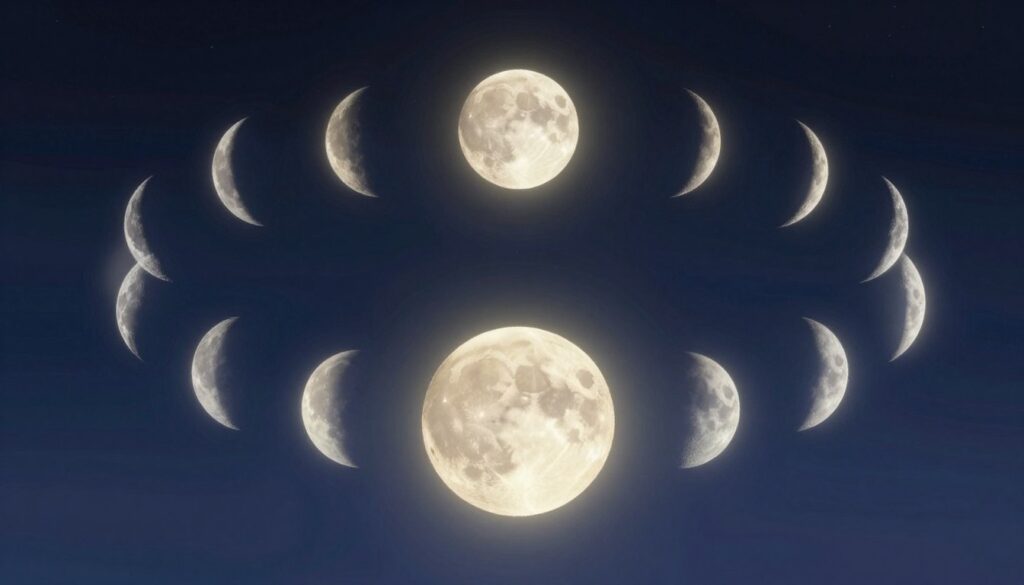
The cycle includes eight distinct phases. These are: new Moon, waxing crescent, first quarter, waxing gibbous, full Moon, waning gibbous, last quarter, and waning crescent.
New Moon
The new Moon happens when the Moon is between the Earth and the Sun. It’s invisible from our planet. This marks the start of a new lunar cycle.
It’s a key time for astronomers. They can see distant stars and galaxies better without the Moon’s light.
First Quarter
When the Moon moves further, it reaches the first quarter. Half of its illuminated side is visible from Earth. This phase shows the Moon as half-illuminated and half-dark.
The first quarter Moon is getting brighter. It’s on its way to full Moon.
Full Moon
The full Moon is when the whole illuminated side of the Moon faces the Earth. It’s fully visible all night. This happens when the Moon is opposite the Sun.
The full Moon is important in culture and astronomy. It’s linked to folklore and myths.
Last Quarter
The last quarter phase shows the other half of the Moon’s illuminated side. It’s half-illuminated and half-dark, but on the opposite side of the first quarter. This phase shows the Moon’s orbit around the Earth.
It’s getting less bright as it moves towards the new Moon again.
Duration of the Lunar Cycle
Exploring the lunar cycle, we find its duration and what affects it are key. Knowing how long the lunar cycle lasts helps us understand the Moon’s behavior and its effects on Earth.
The lunar cycle’s length is measured by the time it takes for the Moon to go through all its phases. This is called a synodic month. Let’s look into what a synodic month is and how it impacts the lunar cycle’s average length.
What is a Synodic Month?
A synodic month is the time it takes for the Moon to orbit Earth and show the same phase again. It’s about 29.5 days long. This is because the Moon’s orbit is not a perfect circle.
The Moon’s orbit changes its distance from Earth, affecting the lunar cycle’s length. This makes the cycle slightly longer or shorter. For more on lunar phases, check out Wikipedia’s Lunar Phase page.
Average Length of a Lunar Cycle
The average lunar cycle, or synodic month, is about 29.5 days. But, because the Moon’s orbit is not a perfect circle, this time can vary. Here are some important points:
- The average duration is 29 days, 12 hours, 44 minutes, and 3 seconds.
- The lunar cycle can vary slightly from one cycle to another due to the Moon’s orbital eccentricity.
- The synodic month is the basis for many lunar calendars used around the world.
Understanding the lunar cycle’s duration is vital for astronomy and culture. By knowing what affects the lunar cycle’s length, we can appreciate the complex relationship between Earth and the Moon.
Cultural Significance of the Lunar Cycle
The lunar cycle is more than just a study in astronomy. It deeply affects our culture and social ways. Many cultures worldwide have been shaped by the Moon’s phases, using them in daily life and traditions.
The lunar cycle is a key part of history and culture globally. It influences many societal practices and traditions.
Lunar Calendars Around the World
Many cultures use lunar calendars to track time. These calendars start with the first crescent of the new moon. For example, the Islamic calendar starts with the new moon sighting. The Hebrew calendar mixes lunar and solar cycles.
Lunar calendars show the Moon’s role in organizing religious, farming, and social events.
- The Islamic Hijri calendar
- The Hebrew calendar
- The Chinese calendar, which uses lunar phases
Festivals and Traditions
The lunar cycle has led to many festivals and traditions. The Mid-Autumn Festival in East Asia celebrates the full moon, symbolizing unity. Harvest festivals worldwide mark the full moon, celebrating the season’s harvest.
- The Mid-Autumn Festival
- Eid al-Fitr, marking Ramadan’s end
- Harvest Moon celebrations
The lunar cycle’s impact on culture shows its lasting importance. We celebrate the Moon’s phases, connecting us to our heritage and each other.
The Science Behind the Lunar Cycle
Exploring the lunar cycle means diving into its scientific roots. It’s shaped by the Moon’s orbit around Earth and Earth’s orbit around the Sun. These factors blend to create the lunar cycle we see.
The changing angles of the Sun’s light as the Moon orbits Earth lead to the phases we observe. This dance between Earth, Moon, and Sun is key to the lunar cycle.
The Earth’s Orbit and Moon’s Phases
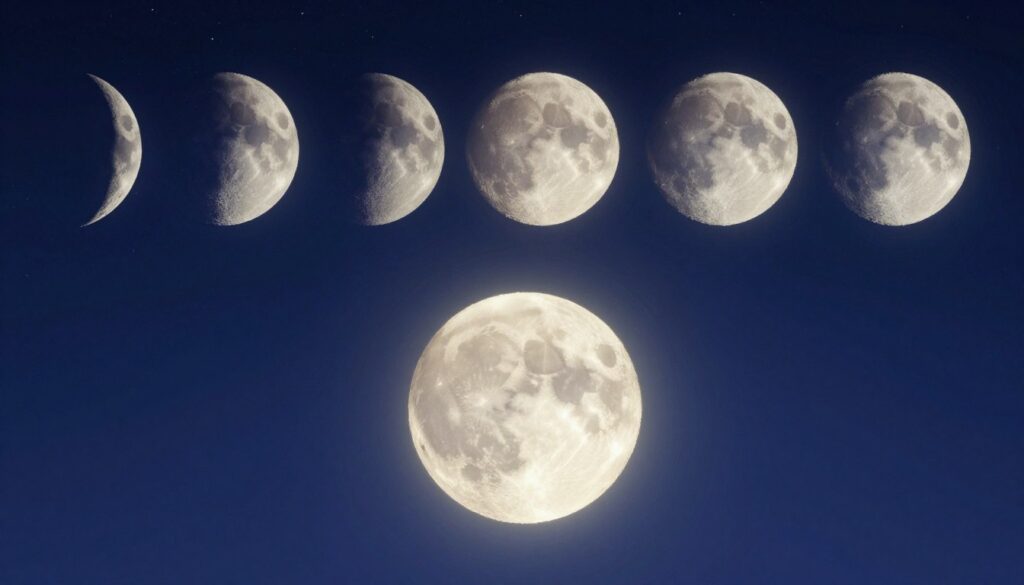
The Moon’s phases come from its orbit around Earth. As it moves, different parts of its illuminated surface face our planet. This is why we see phases from New Moon to Full Moon.
The Earth’s orbit around the Sun also affects the lunar cycle. The Moon’s phase depends on the Earth, Moon, and Sun’s positions. For example, during a New Moon, the Moon is between Earth and Sun, making its side not lit by the Sun.
Tides and Their Connection to the Moon
The Moon’s gravity pulls on Earth’s oceans, causing tides. This pull is strongest during Full Moon and New Moon phases. It makes sea levels rise and fall.
Knowing how the Moon affects tides is important for many activities. It’s key for fishing, coastal management, and gardening. Some gardeners plant seeds with the lunar cycle to boost crop yields. For more on this, check out New Moon Readings for Gardening.
The lunar cycle’s impact on tides is a captivating study. It shows the complex ties between our planet and its satellite. By grasping these connections, we can appreciate the universe’s dynamics more.
Observing the Lunar Cycle
Exploring the lunar cycle shows us the best times to see its phases. It also teaches us about the tools that make viewing better. Watching the Moon can be a fun hobby that teaches us about the Moon and Earth.
Best Times to View Each Phase
The Moon’s phases are visible at different times because of its position. The first and last quarter phases are easy to see during the day. This is because they are at a 90-degree angle to the Sun and Earth.
To get the most out of watching the Moon, knowing when to look is key. The first quarter moon is best seen in the afternoon and early evening. The last quarter moon is visible in the early morning. Knowing these times helps us see the Moon’s phases better.
Tools for Lunar Observation
While we can see the Moon with our eyes, telescopes or binoculars make it better. These tools let us see the Moon’s surface in detail. This gives us a better understanding of the Moon’s geology.
For beginners, binoculars are a great choice. They are easy to carry and use, giving a clear view of the Moon. For those who want more, telescopes offer more detail. Smartphone apps can also help identify the Moon’s phases and when to watch, making it fun and easy.
Myths and Misconceptions
The Moon’s cycles have long fascinated humans. The lunar cycle, about 29.5 days, is complex and has captivated us for centuries. We’ll look at common myths and misconceptions about the lunar cycle.
Common Misunderstandings
Many think a full moon leads to more crime or strange behavior. But, studies show no link between full moons and these issues. For example, ScienceLearn has debunked several Moon myths.
Some believe the Moon greatly affects human behavior. But, the Moon’s gravitational pull mainly impacts tides, not human actions.
The Influence of the Moon on Behavior
The myth that the Moon affects human behavior is widespread. Some think full moons make people act strangely or make bad choices. Yet, research finds no direct link between the Moon’s cycles and human behavior.
Exploring myths about the lunar cycle helps us understand the Moon’s real impact. The lunar cycle is intriguing, but it’s important to know what’s true and what’s not.
The Lunar Cycle in Astrology
Understanding the lunar cycle is key in astrology. It shapes how we read zodiac signs and astrological charts. The lunar cycle’s phases play a big role in these interpretations.
Lunar Phases and Zodiac Signs
The lunar cycle is tied to the zodiac. The Moon goes through each zodiac sign in its cycle. Each Moon phase, from New Moon to Full Moon, affects zodiac signs differently.
A New Moon in a sign is for new starts. A Full Moon is about reaching a peak or letting go.
Here are some key points about lunar phases and zodiac signs:
- The lunar cycle duration is about 29.5 days. This is how long the Moon orbits the Earth.
- Each zodiac sign has traits influenced by lunar phases.
- Astrologers look at the Moon’s phase and position in the zodiac for chart interpretations.
Moon’s Influence on Astrological Readings
The Moon’s phases deeply affect astrological readings. Astrologers say the Moon’s position and phase show insights into personality, emotions, and future events. For example, the current moon phase helps understand current emotional and cosmic influences.
Some key aspects of the Moon’s influence include:
- The Moon’s phase at birth shapes an individual’s emotional nature.
- The Moon’s current phase impacts daily life, with each phase bringing different energies.
- Charts with the Moon’s position offer a deeper look into an individual’s astrological profile.
By grasping the lunar cycle’s role in zodiac signs and astrological readings, we can dive deeper into astrology’s complexities. This knowledge helps us understand its role in our daily lives.
The Impact of Lunar Cycle on Nature
The lunar cycle has a big role in nature. It affects how animals behave and how plants grow. This cycle’s influence is seen in many important parts of our planet’s ecosystems.
Animals and the Lunar Cycle
Many animals follow the lunar cycle. For example, some marine life, like corals and reef fish, breed during the full or new moon. This helps them have better chances of successful reproduction.
Nocturnal animals also change their habits with the moon. For instance, bats and owls hunt more when the moon is full. This is because they can see better in the light.
Plant Growth and the Moon
There’s debate about how the lunar cycle affects plants. Some think the Moon’s gravity changes soil moisture, which could help plants grow. But, there’s not enough proof to say the Moon directly affects plant growth.
Research on plants and the lunar cycle shows mixed results. Some plants grow more in certain moon phases, but others don’t show any difference. Below is a table showing how different plants react to the lunar cycle.
| Plant Species | Lunar Phase | Growth Pattern |
|---|---|---|
| Wheat | Full Moon | Increased growth |
| Tomato | New Moon | Decreased growth |
| Cotton | First Quarter | No significant effect |
To learn more about the Moon’s impact on Earth, check out the Natural History Museum’s article. Also, see how the Moon affects astrology on New Moon Reading Online.
Future of Lunar Research
Lunar research is on the verge of a big change. This is thanks to new missions and advanced science. As we explore the Moon more, we’ll learn more about the lunar cycle length and its role.
Many lunar missions are planned for the next few years. Scientists will gain new insights into the Moon’s makeup, geology, and how it affects Earth. These efforts will help us understand the lunar cycle better. They also open doors to human settlements and using Moon resources.
Upcoming Lunar Missions
Space agencies and private companies are preparing to send missions to the Moon. These missions will greatly improve our Moon knowledge. Some key missions include:
- NASA’s Artemis program, aiming to send humans back to the Moon by 2025.
- The European Space Agency’s (ESA) Lunar Lander mission, to show we can land on the Moon’s surface.
- Private ventures like SpaceX’s Starship, for traveling to the Moon and beyond.
These missions will give us a lot of data on the Moon’s surface and inside. They will help us understand its geological past and if we can get resources from it.
Advances in Lunar Science
New science techniques and tools are helping us study the Moon better. Key areas include:
| Area of Advancement | Description | Impact on Lunar Research |
|---|---|---|
| Remote Sensing | Improved satellite imagery and sensor technologies. | Enhanced understanding of lunar geology and composition. |
| Lunar Sample Analysis | Advanced laboratory techniques for analyzing lunar samples. | Better insights into the Moon’s origin and evolution. |
| Computational Modeling | More sophisticated models simulating lunar processes. | Improved predictions of lunar phenomena and cycle variations. |
These advancements will help us understand the Moon and its cycles, including the lunar cycle length, better. They will also show how the Moon affects Earth.
Conclusion – Embracing the Lunar Cycle
Exploring the lunar cycle shows us how it can make us appreciate the world more. The cycle, lasting about 29.5 days, is complex and interesting. It affects many parts of our lives and nature.
By embracing the lunar cycle, we connect more with Earth’s rhythms. We also see the beauty of the Moon’s phases. The lunar calendar, changing slightly each month, is key in many cultures and astronomy. For those interested in the spiritual side, working with moon phases offers insights into using the lunar cycle in spiritual practices.
Key Takeaways
We’ve looked at the Moon’s phases, the science behind the lunar cycle, and its effects on nature and culture. This knowledge helps us be more mindful and appreciate nature.
Daily Life and the Lunar Cycle
Knowing the lunar cycle can change our daily lives. It helps in planning and setting goals. It also makes us appreciate the night sky more. By following the lunar cycle, we connect deeper with our surroundings.
[…] journal can be incredibly helpful. Tracking energy levels throughout the different phases of the moon allows us to recognize…
[…] Reading is a new platform that offers personalized insights based on the lunar cycle1. It’s different from generic horoscopes,…
[…] As we set intentions aligned with the New Moon energy, we open ourselves to the power of manifestation. By…
[…] intentions during the new moon is a powerful practice that allows me to declare my goals and aspirations. It…
[…] These readings provide a convenient and accessible way to connect with the energies of the new moon and gain…