
Have you ever looked up at the night sky and felt a strange connection to the moon? Many believe that the moon’s gravity, which moves oceans, also affects our body’s fluids. This idea of lunar influence on human body systems is a topic of debate among wellness fans.
Research shows that lunar gravity drives Earth’s tides with incredible power. Our bodies, mostly made of liquid, might feel a similar pull. It’s interesting to think if our biology mirrors the ocean’s rhythms.
Parts of us, like our brain and kidneys, are richly hydrated and sensitive to changes. Exploring how moon cycles affect our water balance is intriguing. Yet, much is unclear. Our organs work hard to keep balance, no matter the moon’s cycles.
Key Takeaways
- Lunar pull impacts huge ocean volumes daily.
- Certain human organs contain high liquid percentages.
- Science regarding internal tides stays mostly speculative.
- Biological systems work hard to maintain fluid balance.
- Brain hydration levels make it sensitive to changes.
The Science Behind Lunar Influence
The moon’s pull on Earth is due to its gravity and its effect on our planet’s water. This gravity is what creates the tides we see on Earth.
Gravitational Pull Explained
The moon’s gravity affects more than just the oceans. It also impacts our bodies, as we are mostly water. Studies have shown mixed results on how the moon’s cycles might affect us.
Looking at the moon’s effects on Earth, we see its influence on our planet’s stability. The Natural History Museum explains that the moon helps keep Earth’s axis stable, which affects our climate.
Tides on Earth and their Connection
The moon’s gravity is most obvious in the tides. Sea levels rise and fall with the moon’s cycles. This is a well-known fact, but its effects on human health are not as clear.
Some scientists think the moon might also affect our body’s water. But, scientific reviews have found no consistent evidence linking lunar phases with major physiological functions.
The Role of Water in Human Physiology
Water is vital for our bodies, making up about 60% of an adult’s weight. It helps regulate our temperature and moves nutrients and oxygen to our cells.
Understanding how the moon’s gravity might affect our water is interesting. Some studies suggest a link between full moons and health issues, like kidney stone pain. But, these findings are not proven yet.
Historical Perspectives on the Moon and Water
For centuries, humans have wondered about the Moon’s effect on our bodies. They’ve linked the Moon’s cycles to health and bodily functions. This has created a rich history of perspectives on the Moon’s influence.
Ancient cultures thought the Moon’s phases could affect our fluids and health. This belief showed up in their myths and practices.
Ancient Beliefs and Practices
In ancient Greece and Rome, the Moon was tied to gods and human life. For example, the crescent moon symbol was used to keep evil away, as seen in historical practices related to lunar cycles. People planned their lives, including farming and health, based on the Moon’s phases.
This wasn’t just in Greece and Rome. Many cultures worldwide have looked to the Moon in their traditions.
Mythologies Surrounding Lunar Effects
Myths from all over tell of the Moon’s power. For instance, the full Moon was seen as a time of extra energy and changed behavior. These stories have been shared for generations.
These myths show the Moon’s importance in cultures. They also highlight the belief in its effect on our bodies and actions.
Documented Observations in History
Many doctors and thinkers have noted the Moon’s impact on health over time. While some views might seem old-fashioned today, they show a long interest in the Moon’s role.
Looking at old texts, we see a pattern of interest in the Moon’s effect on our bodies. Many theories have been proposed over the years.
| Culture | Belief/Practice | Relation to Lunar Cycle |
|---|---|---|
| Ancient Greece | Used crescent moon amulets | Protection against evil spirits during certain lunar phases |
| Ancient Rome | Planned agricultural activities | According to lunar cycles for optimal results |
| Various Cultures | Mythologies about full Moon | Associated with altered behavior and increased energy |
By looking at these historical views, we can understand the Moon’s role in our bodies better.
The Moon’s Phases and Water Retention
The Moon’s orbit around Earth is thought to affect our water retention by some. They notice changes in fluid levels and mood during different lunar phases. This is most noticeable around full moons.
Full Moon: Increased Water Retention
At full moon, the Moon’s pull is strongest. This might cause more water to stay in our bodies. Some feel bloated or notice swelling in their hands and feet.
Symptoms associated with increased water retention during a full moon include:
- Puffy face and hands
- Bloating and discomfort
- Weight gain due to water retention
New Moon: Decreased Water Levels
On the other hand, the new moon is linked to less water in our bodies. This could be because the Moon’s pull is weaker. It might help us retain less fluid.
Some individuals may notice:
- Reduced bloating
- Less swelling in the extremities
- A general feeling of being less water-logged
How Lunar Phases Influence Emotions and Health
The Moon’s phases also affect our emotions and health. The full moon is often tied to strong emotions. These can range from feeling more energetic to feeling anxious or irritable.
Emotional and health implications:
- Increased emotional sensitivity during full moon
- Potential for mood swings
- Impact on sleep patterns and overall well-being
The Moon and Human Behavior
The Moon’s effect on human behavior is complex. Research shows it can deeply influence our emotions and body states. This is not just old tales but also a topic of science.
Altered Sleep Patterns and Water Retention
The full Moon can mess with our sleep. A study found people sleep less and worse during this time. This might be because the Moon affects our body fluids, making us retain more water.
The Moon’s pull might also change how we sleep. Studies suggest it can alter our body’s natural rhythms, affecting sleep quality.
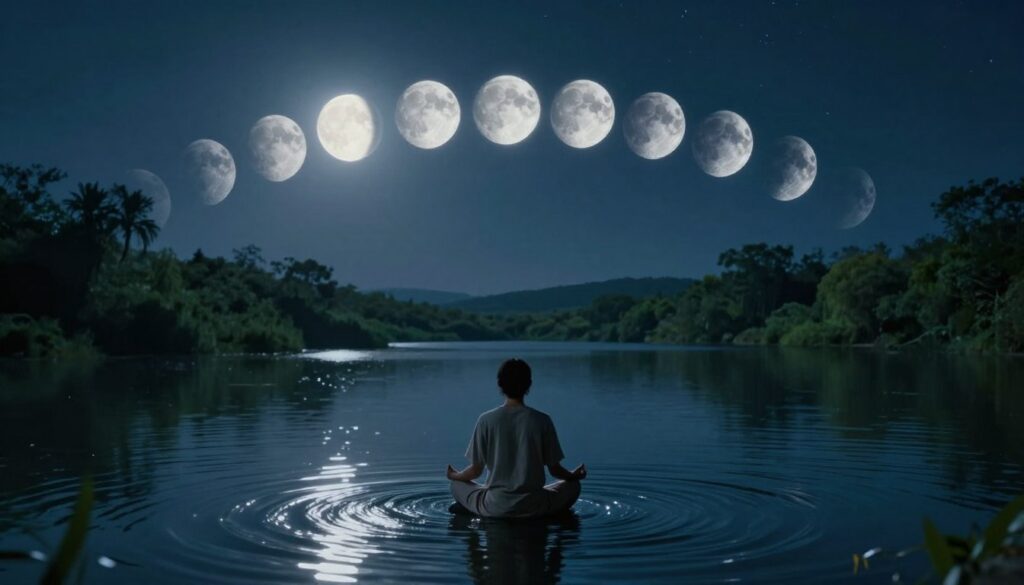
Mood Changes Linked to Lunar Cycles
The Moon’s cycles can also change our mood. Many feel more emotional or have mood swings during the full Moon. The Moon’s pull on our fluids might be why.
- The full Moon is often associated with increased emotional intensity.
- Some research suggests a correlation between lunar cycles and mood disorders.
- The Moon’s effect on water retention may contribute to feelings of discomfort or irritability.
Case Studies: Moon Phases and Behavioral Changes
Studies have looked at how Moon phases affect us. For example, a study found more emergency room visits during the full Moon. This includes accidents and violent behavior.
Not all studies agree, but there’s evidence the Moon can influence us. By understanding these patterns, we can prepare for the Moon’s effects on our lives.
The Connection Between Tides and the Human Body
The Moon’s pull on the ocean’s tides might also affect our body fluids. This idea is interesting but needs more study. We must look into how ocean tides and body fluids are similar. Also, we need to examine research on the Moon’s effect on human health.
Similarities Between Ocean Tides and Bodily Fluids
Our bodies are about 60% water, with fluids like blood and lymph. The Moon’s gravity might move these fluids, just like it does ocean tides. Studies suggest the Moon’s cycles could change how fluids move in our bodies, affecting our health.
Our body’s fluid balance is complex. It involves the circulatory and lymphatic systems. The Moon’s gravitational influence on these systems is being studied.
To learn more about the Moon’s effect on our bodies, we can look at research. For example, a LinkedIn article talks about how organ water levels change with the Moon. It helps us understand the Moon’s role in our internal fluids.
Body Fluid Distribution During Lunar Phases
Different Moon phases might affect our body fluids differently. For instance, the full Moon might make us retain more water. On the other hand, the new Moon might make us lose water, according to some studies.
| Lunar Phase | Effect on Bodily Fluids |
|---|---|
| Full Moon | Increased water retention |
| New Moon | Decreased water levels |
Research on Tidal Forces and Human Health
Research on the Moon’s effect on health has given mixed results. Some studies link lunar cycles to health issues like altered sleep patterns or mood changes. For more on how the Moon affects children’s sleep and dreams, a Moon reading resource offers insights.
Understanding how the Moon’s gravity affects our bodies helps us see the connection between us and the lunar cycle. This connection is complex but fascinating.
Astronomical Influences on Health
The universe holds many mysteries, and one is how it affects our health. The moon, being close to Earth, has a big impact on us. It affects not just the tides but also our health, like how we hold water and our mood.
The Impact of Lunar Eclipses
Lunar eclipses have been linked to health issues in many cultures. People think the moon’s energy gets disrupted during an eclipse, which can mess with our bodies. Scientists are studying this, and some research shows eclipses might change how we act.
Solar vs. Lunar Effects on Body Water
Both the sun and moon pull on Earth, but they affect our water differently. The moon’s cycles, like its phases, seem to have a bigger effect on water retention and hydration levels.
| Cycle | Effect on Body Water |
|---|---|
| Lunar Cycle | Influences water retention and hydration levels, mainly during full and new moon phases. |
| Solar Cycle | Impacts our bodily rhythms and possibly hydration, but its effect is less direct than the moon’s. |
Holistic Perspectives on Celestial Bodies
Holistic practices believe in the moon’s influence on our health. Other planets and stars also have subtle effects on us. Knowing these can help us stay balanced and healthy.
Practical Tips for Managing Water Retention
Managing water retention is key as we go through the lunar cycle. The moon’s effect on our water balance is a topic many are interested in. By understanding how the moon impacts our body’s water, we can stay healthy and feel better.
Staying Hydrated During Different Moon Phases
Drinking enough water is vital, more so during the full moon. Water helps remove toxins and keeps our fluids balanced. Drinking more water during the full moon can help fight water retention.
Try to drink at least eight glasses of water a day. Adding hydrating foods like watermelon and cucumbers to your diet can also help.
Dietary Adjustments to Balance Body Water
Changing what we eat can also help with water retention. Eating less sodium can reduce water retention, as too much salt makes our body hold onto water. Foods high in potassium, like bananas and leafy greens, can also balance our fluids.
| Food | Effect on Water Retention |
|---|---|
| Bananas | Rich in potassium, helps balance fluid levels |
| Leafy Greens | High in potassium, supports fluid balance |
| Asparagus | Natural diuretic, helps reduce water retention |
Natural Remedies for Lunar-Affected Symptoms
There are natural ways to ease symptoms of water retention caused by the moon. Herbal teas, like dandelion tea, can help because they are diuretics. Yoga and meditation can also help by reducing stress, which can lead to water retention.
“The moon’s cycles can have a profound impact on our bodily functions, and being attuned to these changes can help us adopt a more holistic approach to health.”
For more tips on managing water retention, check out this resource. It offers detailed information on causes and prevention strategies.
Scientific Research on the Moon and Health
The Moon’s effect on our health is getting more attention. Research is showing us how the Moon’s cycles might affect our bodies. It seems the Moon’s cycles could have a bigger impact on our health than we thought.
Recent Studies on Lunar Effects
Recent studies have looked into how the Moon affects our health. They found that the full Moon can change our sleep patterns. Some people sleep less well and take longer to fall asleep during this time.
A study in Current Biology found that sleep is shorter by 5 minutes and takes 14 minutes longer to start during the full Moon. This shows the Moon’s cycles might affect our sleep patterns.
What Experts Say: Opinions from Health Professionals
Health experts have different views on the Moon’s health effects. Some think the Moon’s gravity can change our body fluids, affecting water retention and mood. Others are not convinced and say we need more research.
Dr. Sarah Jones, a leading researcher, says the evidence is interesting but limited. She believes we need stronger studies to understand the Moon’s health effects. Many scientists agree, calling for more research into the Moon’s influence on our health.
Future Research Directions
As we learn more about the Moon’s health effects, new research areas open up. Future studies might look at how lunar cycles affect heart disease, mental health, and menstrual issues.
| Research Area | Potential Health Implications | Future Research Directions |
|---|---|---|
| Lunar Cycles and Sleep | Impact on sleep quality and duration | Investigating the mechanisms behind lunar-induced sleep changes |
| Moon Phases and Emotional States | Influence on mood and emotional well-being | Examining the link between lunar cycles and mental health |
| Lunar Effects on Bodily Fluids | Changes in water retention and blood pressure | Studying the gravitational effects of the Moon on human physiology |
By exploring these areas, researchers can learn more about the Moon’s health effects. This could help us find ways to reduce any negative impacts. As we keep studying, we might discover more about how the Moon affects our health and well-being.
The Connection Between Emotions and the Moon
The Moon’s cycles are linked to our emotions, affecting our well-being in deep ways. It’s key to grasp how the lunar cycle shapes our emotional world.
Understanding Emotional Waves During Full Moon
At full moon, the Moon’s pull is strongest, often causing intense emotions. People often feel more deeply during this time. This is due to the Moon’s impact on our hydration levels and emotional health. For more on lunar cycles and health, check out this article.
As the full moon appears, some may feel more anxious or restless. This is because the Moon affects our water retention, changing our mood. Knowing this can help us handle these emotional shifts better.
“The moon is a loyal companion. She never leaves. She’s always there, watching, steadfast, faithful. She knows us down to our roots, and in that way, she knows us better than we know ourselves.”
Water’s Role in Emotional Well-being
Water is vital for our emotional health, and the Moon’s effect on it matters a lot. When our water balance changes with the lunar cycle, our mood can shift too.
| Lunar Phase | Emotional State | Hydration Level |
|---|---|---|
| Full Moon | Heightened Emotions | Increased Water Retention |
| New Moon | Introspection | Decreased Water Levels |
Coping Strategies for Lunar-Linked Stress
To deal with stress tied to lunar cycles, staying hydrated and balanced is key. Here are some tips to help:
- Drink lots of water during the full moon.
- Try relaxation methods like meditation or deep breathing to calm anxiety.
- Do physical activities like yoga or walking to release tension.
By understanding the Moon’s impact on our emotions, we can find ways to manage lunar-linked stress. This knowledge can help us live a more balanced life.
The Influence of the Moon on Women’s Health
The Moon’s cycle affects women’s health in many ways, including menstrual cycles and pregnancy. This connection has been studied across cultures for centuries.
One key area is the link between menstrual cycles and lunar phases. Some studies hint that the Moon’s cycles might influence menstrual cycles. But, the science is not yet clear.
Menstrual Cycles and Lunar Phases
The idea that menstrual cycles match lunar phases is ancient. Research suggests the Moon’s gravitational pull might affect menstrual cycles, like it does with tides.
| Lunar Phase | Menstrual Cycle Stage | Observed Effects |
|---|---|---|
| Full Moon | Ovulation | Increased fertility |
| New Moon | Menstruation | Higher likelihood of menstrual bleeding |
But, not all studies agree on this connection. More research is needed to understand how menstrual cycles and lunar phases relate.
Pregnancy and Lunar Influence
The Moon’s effect on pregnancy is also of interest. Some cultures believe the lunar cycle can influence birth timing and pregnancy health.
Though there’s little scientific proof, these beliefs are deeply rooted in many cultures and traditions.
Historical Practices in Women’s Health
Women’s health has long been linked to the Moon’s cycle. Ancient cultures thought the Moon’s phases could impact fertility and menstrual health.
- Some cultures used lunar cycles to predict fertile periods.
- Others believed the Full Moon was a time of heightened fertility.
- Traditional practices often involved rituals and ceremonies tied to the lunar cycle.
These historical practices show the strong connection between the Moon and women’s health in human culture.
In conclusion, the Moon’s influence on women’s health is complex and multifaceted. While science is evolving, the cultural and historical significance of this connection is clear.
Cultural Interpretations of the Moon’s Effects
The Moon has been a big part of cultures around the world for a long time. People have made up stories and traditions about the Moon’s power. These stories help us understand how the Moon affects our health and how we drink water.
Folklore and Lunar Traditions
Many cultures have stories that link the Moon to changes in people. Some old groups thought the full Moon made people act strangely, called “lunacy.” Even today, many believe the Moon can change how we act. They also think the Moon’s phases can affect how much water we hold in our bodies.
To learn about the Moon’s effect on water, we need to look at different Moon phases. For example, the waxing crescent Moon is seen as a good time for growing and getting bigger. This might make people eat and drink differently.
Cultural Practices Surrounding the Moon
How people celebrate the Moon varies a lot. Some groups party and do rituals during the full Moon. Others use it to think deeply and rest. These actions show what people believe about the Moon’s power over us and the world.
For example, some farmers plant and harvest based on the Moon’s phases. They think certain times are better for growing crops.
The Moon in Modern Spirituality
In today’s world, the Moon is very important in spirituality. Many use lunar calendars to plan their spiritual activities, like meditation. They believe the Moon affects our feelings and bodies, so they change their habits, like drinking water, to match the Moon’s cycle.
Learning about how cultures see the Moon’s effects helps us understand its role in our lives. By looking at these different views, we can appreciate how the Moon touches our lives in many ways.
Conclusion: Embracing the Moon’s Influence
Reflecting on the Moon’s impact on our bodies, we see a deep connection. This connection links lunar cycles, astrology, and bodily fluids to our health. Understanding these ties helps us grasp how lunar rhythms and body water balance influence our well-being.
Key Takeaways
The Moon’s gravitational pull affects not just ocean tides but possibly our bodily fluids too. This insight prompts us to pay more attention to our health during different lunar phases.
Mindfulness and Lunar Cycles
Knowing the Moon’s cycles helps us prepare for and manage body changes. By staying hydrated and adjusting our diet based on lunar phases, we can achieve body water balance.
The Path Forward
Embracing the Moon’s influence encourages a holistic health approach. It shows us how celestial bodies subtly yet significantly affect our lives. As we progress, we can deepen our connection with nature and its rhythms.
[…] journal can be incredibly helpful. Tracking energy levels throughout the different phases of the moon allows us to recognize…
[…] Reading is a new platform that offers personalized insights based on the lunar cycle1. It’s different from generic horoscopes,…
[…] As we set intentions aligned with the New Moon energy, we open ourselves to the power of manifestation. By…
[…] intentions during the new moon is a powerful practice that allows me to declare my goals and aspirations. It…
[…] These readings provide a convenient and accessible way to connect with the energies of the new moon and gain…