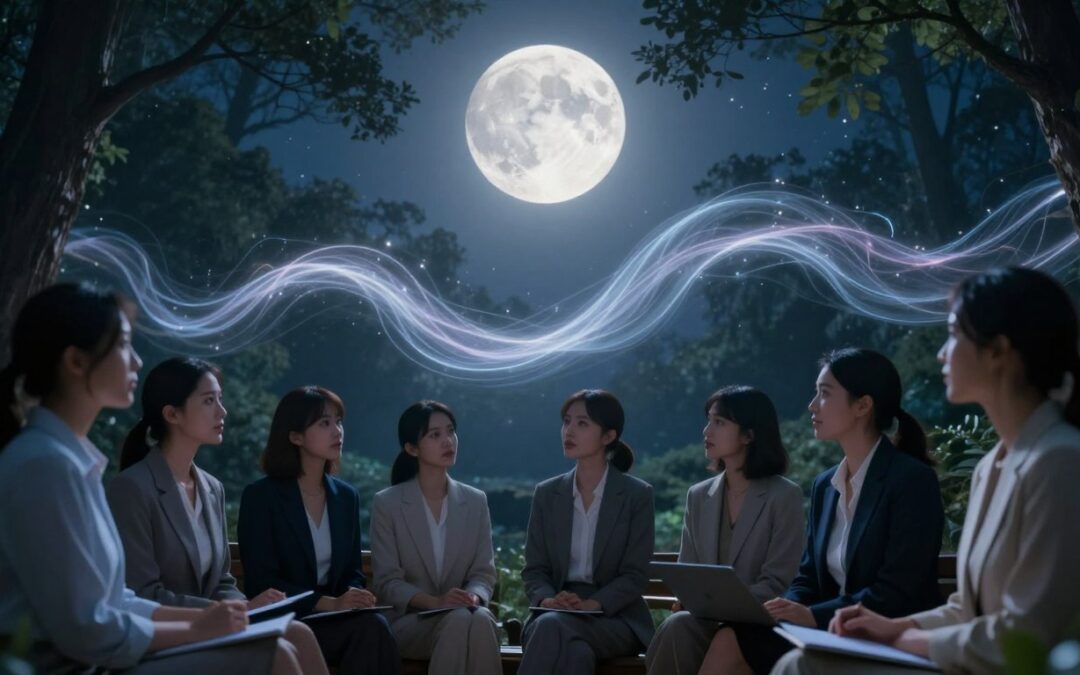
Ever thought the moon might control your body’s natural rhythms? For ages, many believed the moon and our fertility were connected. It’s common for women’s periods to sync up with the moon’s 29.5-day cycle.
Is this just a coincidence, or is there a deeper link? Modern science used to think these ideas were myths. But new studies show that moonlight can really affect our sleep and mood.
Recent studies look at how periods used to match the and how our lifestyle changed this connection. We’ll see how gravity and light guide our internal clocks. Find out how does the moon affect menstrual cycles as we uncover this intriguing scientific mystery.
Key Takeaways
- Female periods and lunar months both average roughly 29.5 days.
- Ancient cultures historically linked celestial phases to human fertility.
- Scientific research suggests that gravity and light influence our biology.
- Artificial nighttime lighting has reduced strength of natural synchronization.
- Lunar transitions can noticeably impact sleep quality and daily moods.
- Synchronization appears strongest during winter solstice and specific standstills.
The Basics of Menstrual Cycles
Menstrual cycles are a natural part of life for many women. They are influenced by a delicate balance of hormones. Knowing about menstrual cycles helps women track their reproductive health and make informed decisions about their bodies.
What is a Menstrual Cycle?
A menstrual cycle is the monthly series of changes that prepare a woman’s body for pregnancy. It’s controlled by hormones like estrogen and progesterone. These hormones regulate the cycle’s phases. For more information, visit Healthline’s article on menstrual cycles and the.
Phases of the Menstrual Cycle
The menstrual cycle has four phases: menstruation, the follicular phase, ovulation, and the luteal phase.
- Menstruation: This is the shedding of the uterine lining, resulting in bleeding.
- Follicular Phase: During this phase, the body starts to produce follicle-stimulating hormone (FSH). This hormone stimulates the growth of follicles in the ovaries.
- Ovulation: The release of an egg from the ovary, usually occurring mid-cycle.
- Luteal Phase: After ovulation, the empty follicle in the ovary forms the corpus luteum. This corpus luteum produces progesterone to prepare the uterine lining for a fertilized egg.
Average Cycle Length
Each woman’s menstrual cycle is unique, with an average length of 28 days. But, cycle lengths can vary a lot among women and can change over time. Factors like age, lifestyle, and health can affect cycle length.
It’s interesting to note that the average cycle length tends to shorten with age. Knowing these variations helps women identify any issues and keep their reproductive health in check.
Understanding the Moon’s Phases
Exploring the moon’s effect on menstrual cycles starts with knowing the moon’s phases. The lunar cycle has been studied for centuries. Its phases are not just different to look at but also carry deep meaning in astrology and culture.
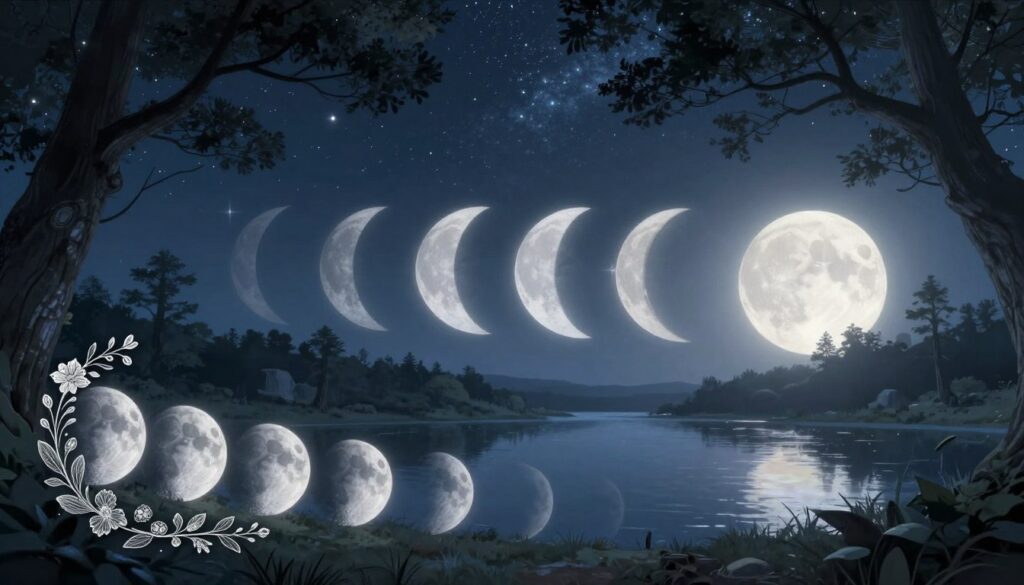
The lunar cycle is marked by its phases, based on the moon’s position against the Earth and sun. It starts with the new moon, then moves to the waxing crescent, first quarter, and so on. The cycle ends with the waning crescent before starting again at the new moon.
Overview of Lunar Phases
The moon takes about 29.5 days to orbit the Earth, completing one cycle of phases. This cycle is called a synodic month or lunation. The moon’s phases change as it orbits, due to the sun’s light angle.
The Lunar Cycle and Its Duration
There are various lunar cycles, each lasting differently. The most common is the synodic month, lasting 29.5 days. Other cycles include the anomalistic month and the tropical month, each with its own duration.
| Type of Lunar Cycle | Duration (Days) | Description |
|---|---|---|
| Synodic Month | 29.5 | Time for one complete cycle of phases |
| Anomalistic Month | 27.5 | Time from perigee to perigee |
| Tropical Month | 27.3 | Time to return to the same sky position relative to Earth’s equator |
Knowing these cycles can help us understand how the moon affects our bodies, like menstrual cycles. Research is exploring this link. For example, a study on menstrual cycles and the body’s internal clock found interesting connections with lunar phases, as discussed on Science Focus.
Historical Beliefs and Folklore
Many cultures have linked the moon’s cycle to the menstrual cycle. They’ve woven these connections into their myths and daily lives. The moon’s influence on menstruation has been both fascinating and revered.
Ancient Cultures and the Moon
In Ancient Greece, doctors thought the moon and menstrual cycles were connected. Women were seen as spiritually and mentally strong during their periods. This shows how important lunar cycles were in ancient cultures.
Many indigenous cultures also have stories linking the moon to fertility and women’s health.
- The Native American tribes believed the moon controlled women’s menstrual cycles and fertility.
- In some African cultures, the moon is tied to female fertility gods and goddesses.
Folklore Around Menstruation and the Moon
Folklore about menstruation and the moon varies widely. Some believe a woman’s cycle aligns with the moon’s phases for spiritual connection or fertility. Learn more about this myth in this article.
- Some believe menstrual blood has magical powers during specific lunar phases.
- Others practice rituals and ceremonies with the lunar cycle to match menstrual cycles.
- There’s a belief that women in sync with the moon are more connected to nature.
These beliefs show a deep connection between lunar observations and menstrual experiences across cultures.
Scientific Studies on Lunar Effects
Recent studies have looked into the connection between lunar phases and menstrual cycles. This research is interesting because it connects to old beliefs about the moon’s effect on women’s health.
Overview of Research Studies
Many studies have checked if the lunar cycle and menstrual cycle are linked. For example, a 2021 study in Science Advances found some women’s periods match the moon’s light and gravity cycles at certain times. This shows there might be a complex relationship between the moon and menstrual health.
These studies often track women’s cycles over time and compare them to the moon’s cycles. Some research uses data from many women to find patterns.
Key Findings from Recent Research
Some important findings from recent studies are:
- Synchronization with Lunar Cycles: Some research shows women’s menstrual cycles can sync with lunar cycles, mainly in certain groups or situations.
- Variability in Menstrual Cycles: The way women’s cycles match lunar phases varies a lot, showing individual factors are key.
- Lunar Influence on Hormones: Some studies suggest the moon’s cycles might change hormones, which could affect menstrual health.
These findings are fascinating and need more study. As research goes on, we might learn more about how the moon impacts menstrual health.
Synchronization of Menstrual Cycles with Lunar Phases
The idea of lunar synchronization links the moon’s cycles to women’s menstrual cycles. It suggests the moon’s phases might affect when and how often women get their periods.
The Concept of Lunar Synchronization
Lunar synchronization means menstrual cycles might match the moon’s cycle. The moon’s cycle, about 29.5 days, is close to a menstrual cycle’s average length of 28 days. This similarity has made people wonder if there’s a connection between the two.
Some studies suggest the moon’s pull or light might change hormones, affecting menstrual cycles. But, it’s important to look at the evidence for this connection.
Evidence Supporting Lunar Effects on Menstruation
Research on linking menstrual cycles to lunar phases has shown mixed results. Yet, some compelling findings hint at a connection. For example, a study found some women’s periods sometimes matched the full or new moon.
The study showed menstrual rhythms varied a lot among women and over time. Looking at the six women who recorded the longest, five had periods that sometimes matched the moon. 
This evidence, though not definitive, hints at a possible link between the lunar cycle and menstrual cycles. More research is needed to understand this connection fully.
The Role of Light and Darkness
Exploring the moon’s effect on menstrual health, light exposure is key. The moon’s cycles can change human biology. Knowing how light affects our body rhythms is important.
Research on menstrual cycles and the moon shows interesting findings. Most women studied lived in rural areas. This means they could see the moon’s brightness better. This visibility might affect their menstrual cycles.
Moonlight and Biological Rhythms
Moonlight affects biological rhythms in many species. For humans, natural light-dark cycles help regulate our internal clock. This can influence hormone balances, which are important for the menstrual cycle.
“The lunar cycle’s influence on the human menstrual cycle could be mediated through the effects of moonlight on the body’s internal clock.”
Connection Between Light Exposure and Menstrual Cycles
Studies show light exposure impacts menstrual cycle regularity. Women with more natural light during the day and darkness at night have regular cycles. Moonlight, a natural light source at night, is of special interest.
| Light Exposure | Effect on Menstrual Cycle |
|---|---|
| Natural Day-Night Cycle | Regulates Circadian Rhythms, Potentially Influencing Menstrual Regularity |
| Moonlight | May Influence Hormonal Balance, Affecting Menstrual Cycle |
| Artificial Light at Night | Can Disrupt Circadian Rhythms, Potentially Irregular Menstrual Cycles |
Light exposure and menstrual health are linked. The moon’s cycle might influence menstrual cycles. Light is key to many bodily functions.
Hormonal Influences and the Moon
The link between the lunar cycle and menstruation has always fascinated people. Many think the moon’s phases affect hormone changes in women. Ayurveda says blood, or “rakta” in Sanskrit, is ruled by the moon. This shows an old belief that women’s health is linked to the moon’s rhythms.
Hormonal Changes Throughout the Cycle
The menstrual cycle is controlled by hormones. Knowing how these hormones change helps us see how the moon might affect menstruation.
Hormones like estrogen and progesterone change a lot during the cycle. Estrogen goes up during the first part, and progesterone during the second. This balance is key for a regular cycle.
Dr. Laura Newcomer, an expert in women’s health, says, “The changes in hormones during the cycle are complex. They can be affected by things like the lunar cycle.”
How Lunar Phases May Influence Hormones
Some studies and old beliefs say the moon can affect hormone levels. For example, the full moon might make estrogen levels go up, making periods stronger for some. The new moon is sometimes seen as a time for renewal, linked to menstruation.
“Women were thought to be healthier when their cycles matched the moon’s,” an old belief shows the moon’s connection to menstrual health.
Research on how the moon affects hormones is needed. Some women say their cycles match the moon, but others don’t. This shows how complex hormones are in menstrual cycles.
Looking at how hormones and moon phases interact helps us understand menstrual health better. This connection is both rooted in tradition and open to scientific study.
Individual Variations in Menstrual Cycles
Menstruation is not the same for everyone. Many things, like the moon’s phases, can affect our cycles. Each woman’s experience is unique, influenced by many factors.
Factors Affecting Menstrual Cycles
Many things can change our menstrual cycles. Hormonal changes are key, but so are stress levels, diet, and health.
Stress or health issues can make cycles irregular. What we eat and how much we exercise also matters.
Personal Experiences and Lunar Connections
How women feel about their cycles and the moon varies a lot. Some see a link between their cycle and the moon. Others don’t notice any connection.
For those who feel a lunar link, it can help them understand their cycles better. Keeping a menstrual diary or using a moon phase calendar can reveal patterns unique to them.
Practical Tips for Tracking Your Cycle
Tracking your menstrual cycle with the moon’s phases can reveal a lot about your body’s rhythms. It helps you see how your body and the moon are connected. This connection can give you insights into your health.
Using a Moon Phase Calendar
A moon phase calendar is a great tool for tracking the lunar cycle. It lets you see patterns and connections with your menstrual cycle. You can find these calendars online or download apps that show the moon’s phases.
Apps like Mira, Natural Cycles, Clue Period Tracker, Flo Period & Ovulation Tracker, and Cycles are helpful. They let you track your cycle and compare it with the moon’s. This makes it easier to spot any connections.
Key benefits of using a moon phase calendar include:
- Enhanced awareness of your menstrual cycle
- Better understanding of the lunar cycle’s influence on your body
- Identification of patterns and correlations between your cycle and the moon’s phases
Journaling Menstrual and Lunar Phases
Journaling is a powerful way to track your cycle and its lunar connection. By recording your cycle dates and lunar phases, you learn more about your body’s rhythms. For inspiration, check out new moon reading online with journaling.
To start journaling, just write down your period date and the lunar phase. Over time, you’ll see patterns and connections. For more tips on syncing your cycle with the moon, see this resource.
Using a moon phase calendar and journaling together can deepen your understanding of your cycle and its lunar connection. This approach helps you manage your menstrual health better. It also strengthens your connection with your body’s natural rhythms.
Conclusion: Embracing the Connection
Exploring the link between the moon and menstrual cycles shows us how important it is. It can greatly improve our health. Many cultures have believed in this connection for a long time.
Key Takeaways
We’ve looked at the basics of menstrual cycles and the moon’s phases. We’ve also seen historical beliefs and scientific studies. Even though science is not always clear, many people find tracking their cycles with the moon helpful.
Final Reflections
Understanding the moon’s effect on our menstrual health can deepen our connection with our bodies and nature. Recognizing the moon’s influence on our cycles helps us see health in a more complete way. As we learn more, we discover the many connections that shape our lives.
[…] journal can be incredibly helpful. Tracking energy levels throughout the different phases of the moon allows us to recognize…
[…] Reading is a new platform that offers personalized insights based on the lunar cycle1. It’s different from generic horoscopes,…
[…] As we set intentions aligned with the New Moon energy, we open ourselves to the power of manifestation. By…
[…] intentions during the new moon is a powerful practice that allows me to declare my goals and aspirations. It…
[…] These readings provide a convenient and accessible way to connect with the energies of the new moon and gain…